

Concordia Seminary Newsroom
Speaking the Creed
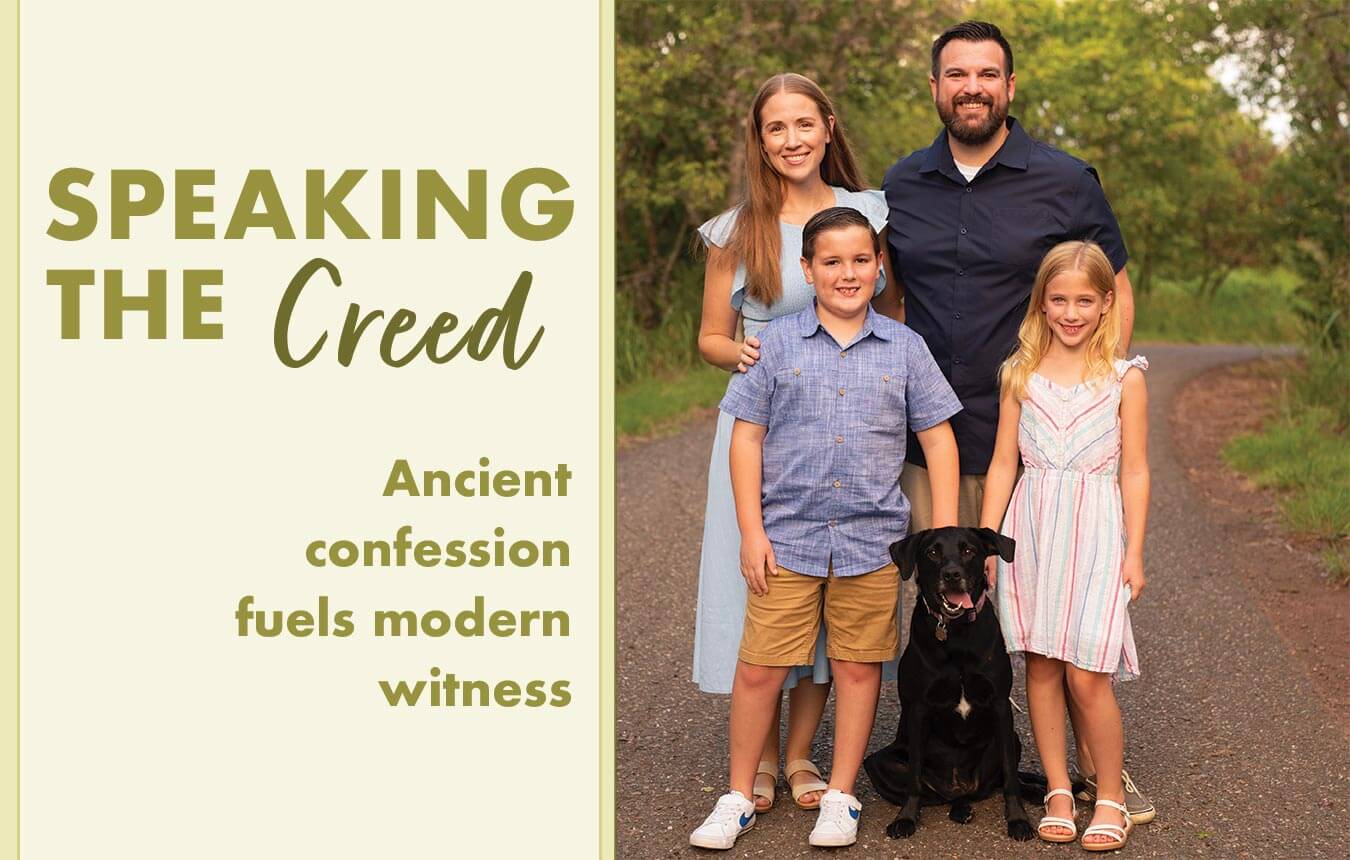
If you could no longer wear a cross to work, how would you witness your faith? If someone asked who Jesus is, or what you believe, how would you respond?
For Pastor Daniel Ross, the answer does not take long. It takes about 45 seconds — the time it takes to speak the Apostles’ Creed.
Ross (’11), who serves as The Lutheran Church—Missouri Synod’s Oklahoma District evangelism executive, pastor at Christ Lutheran Church in Mustang, Okla., and a church planter, points to the Creed as a faithful, time-tested way to speak clearly about the Christian faith.
“The ancient church gave us those words because people were asking, ‘What is it you believe?’” Ross says. For centuries, believers have used the Creed to confess Christ in every setting and Ross believes the same is true today.

That historic statement shapes how Ross approaches ministry and evangelism. Whether from the pulpit, in Bible studies or during confirmation classes, he intentionally returns to the Creed as a foundation for witnessing. His goal is to encourage his congregation to see themselves not as spectators, but as everyday evangelists who can speak clearly and confidently about their faith.
On Sunday mornings, his Bible study group is working through the Book of Acts. Fifteen sessions in, they have only reached Chapter 5. The deliberate pace is by design. “You can be intentional and encourage people in outreach, mission and witness by talking about it in sermons and walking through it in Bible studies on a regular basis,” says Ross.
He uses the text to ask challenging questions about how believers today can share their faith, just as the early church did. Ross regularly encourages members to think about how they might respond when challenged about their faith, and how the Creed gives them words that are both ancient and living. He recounts the stories of martyrs and Paul’s dramatic conversion, drawing connections between the courage of the first Christians and the witness opportunities believers face now.

Ross’ passion for evangelism is rooted in personal experience. As a Seminary student, he traveled to Russia and visited a forest where victims of Soviet persecution were buried in unmarked graves — sometimes 15 to 20 people at a time. Their only crime was refusing to renounce their faith.
He still remembers meeting two elderly women who the KGB had taken from their village, placed on a train with other victims and dropped in the middle of Siberia with no food or tools. Told to survive the winter on their own, many in their group perished before the KGB returned in spring. The women’s unwavering faith left a lasting impression on Ross.
Stories like theirs give him perspective when talking about the challenges Christians face today. Ross quickly acknowledges growing cultural hostility, targeted attacks on places of worship, violence and increasing pressure on believers. Yet, he views these difficulties not as reasons for fear, but as opportunities to share the hope of Christ.
“There’s nothing new, it just looks different,” Ross says. “The Lord has still won the victory, and that’s a great way to introduce people to the Gospel.”

Church planting is one of the ways Ross puts that belief into action. “I talk about it constantly,” says Ross. “It’s probably why I got elected as my district evangelism executive, which in Oklahoma is an added responsibility on time, especially when you’re in a parish.” He sees church planting both as evangelism and as a base for ongoing outreach.
“Church plants tend to attract people who have become de-churched for a variety of reasons. That’s evangelism,” he says. “But it also provides a base for outreach. There’s a presence there. People are gathered together and the Word does not return empty.”
Personal invitations play a key role. Ross believes no program is more effective than one person inviting another. This kind of connection not only gathers people into worship but also fosters the environment where future pastors are raised.
“God calls pastors from congregations,” Ross often says. He sees church plants as a way to increase opportunities for the Gospel to be heard and for the Holy Spirit to work. It is also a long-term commitment and formation. He is quick to point out that a new congregation can take decades to form leaders and future pastors. Ross readily acknowledges that church planting is not about his efforts but about God’s work in God’s time.

Ross is eager to encourage current and future seminarians who may feel unprepared for ministry. He often reminds them that God places people where He wants them to serve. He sees the Seminary not simply as a place for academic training, but as the beginning of a lifetime of formation.
“Seminary is not an education. Seminary is a formation, which means that you are given the tools that you will use for the next 30, 40 or 50 years.” Ross continues, “Who is to say what society is going to look like in 30 years, toward the end of your ministry, but you have been given the tools to keep learning, to keep adapting and to keep proclaiming God’s Word where God has called you.”
He also encourages new pastors to lean on fellow pastors, their district and the Synod. “It is not you versus the world,” Ross says. “You are part of The Lutheran Church—Missouri Synod, walking together and with support resources to help with church plants, to help with outreach. Trust in the Lord, because the outcome is based on the Lord.”

Ross sees church plants, evangelism and pastoral formation as extensions of the same mission that began with the apostles. Just as the early church used the Creed to confess the faith in a hostile world, today’s believers can use those exact words to witness in a changing culture.
At the heart of Ross’ message is a conviction that Christians are eager to proclaim the Gospel and that the church already possesses the language to do it. He believes people today are hungry for what is enduring. In a culture where so much feels unstable, the unchanging Word of God, the liturgy and the ancient confessions offer solid ground.
“People are eager to hear the Word. They are eager for liturgy. They are eager for things that are historic because everything else around them feels like sand,” he says.
For Ross, that is the heart of evangelism — ancient words spoken with living faith. The same confession that shaped the witness of the early church still shapes believers now, linking modern voices to a timeless testimony.